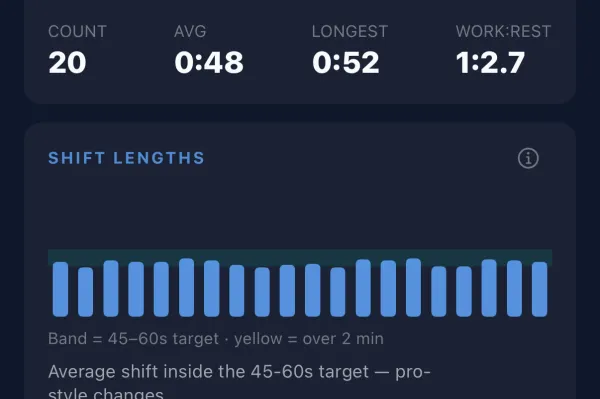
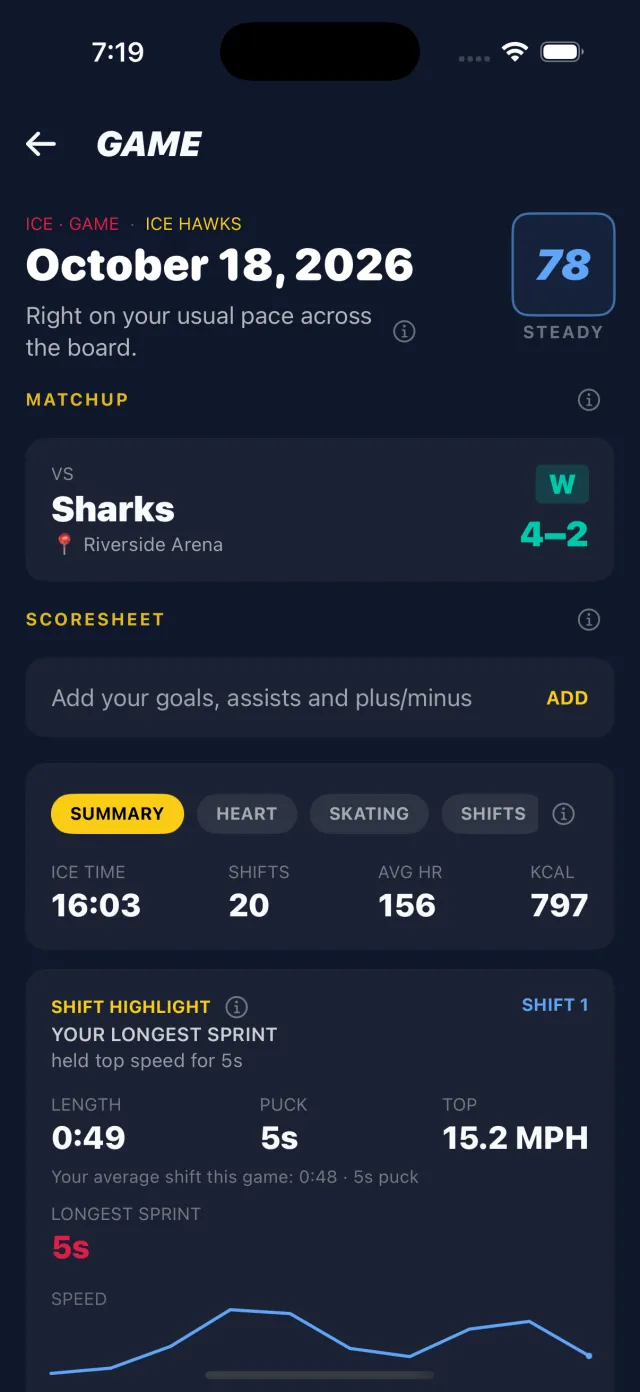
Shift detection means working out, automatically, when a player goes over the boards and when they come back to the bench. Do that for a whole game and you know their ice time, how many shifts they took, how long each one was and how long they rested in between, without anybody pressing a button.
Why not just press a button?
Because nobody does. You're wearing gloves, you're out of breath, and the moment you're thinking about the watch you're not thinking about the game. A stopwatch on the bench doesn't survive the first period either. Pro teams have staff and arena tracking systems for this; beer leaguers have a wrist.
How a watch tells the ice from the bench
A smartwatch has motion sensors: an accelerometer and a gyroscope that measure how your wrist moves many times a second. Skating has a rhythm. Every stride swings your arm, crossovers and stops jolt it, and stickhandling adds quick turns. Sitting on the bench, your wrist is mostly still. Heart rate helps too: it climbs during a shift and falls on the bench.
The watch doesn't flip between "on ice" and "on bench" on a single reading. It waits for sustained evidence before it commits, so a fist bump on the bench isn't a shift and a glide through the neutral zone isn't a rest. It doesn't need GPS, which doesn't work in an arena anyway.
Why it's harder than it sounds
- Standing still on the ice during a stoppage or a faceoff looks a lot like sitting on the bench. This is the hardest case.
- Quick changes leave very little bench time between two shifts, so they can blur into one.
- Everyone skates differently, and a defenceman's shift doesn't look like a forward's.
We check NextShift against rink video of real rec games, shift by shift, and every change to the detector is measured that way before it ships.
What you get once every shift is logged
- Real ice time, not a guess.
- Shift lengths against the 45 to 60 second target. See how long a shift should be.
- Work-to-rest ratio: time on the ice against time on the bench.
- Bench recovery: how quickly your heart rate drops between shifts.
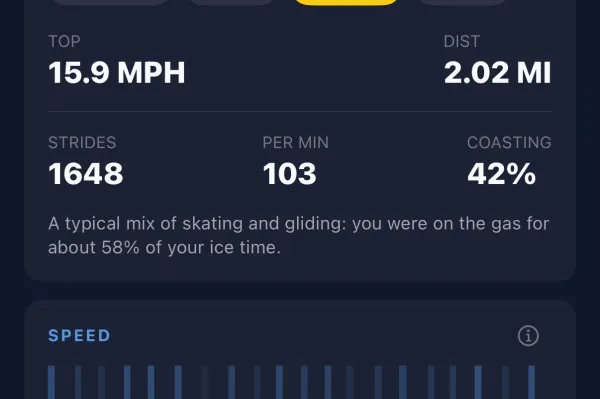
- Per-shift speed and strides, and whether you faded late in the game.
More on how NextShift does it: shift detection in NextShift.