Short answer: 45 to 60 seconds. NHL shifts average well under a minute, and rec players, who are less fit and play fewer lines deep, need short shifts even more than the pros do. A shift that passes the two-minute mark isn't you working hard. It's you, tired, in front of your own net.
Why short shifts work
Hockey is played in sprints. The energy system that powers an all-out burst fades badly after the first half-minute or so of hard effort. Past that point you are still on the ice, but you're slower to every puck, later on every backcheck, and more likely to take a lazy penalty. Your legs can't recover while you're still skating on them; they recover on the bench.
That's also why the length of your rest matters as much as the length of your shift. Coaches talk about the work-to-rest ratio: time on the ice against time on the bench. With three lines, roughly 1 to 2 is normal, meaning a 45-second shift followed by about 90 seconds of rest. Stay out for two minutes and you've stolen the next line's ice time and left yourself less rest at the same time.
What long shifts cost
- Goals against. Tired players get caught. Most beer-league goals against come late in a shift, after a turnover nobody had the legs to recover from.
- Your linemates' ice time. Every extra minute you take is a minute someone on the bench doesn't get.
- Your third period. Long shifts early add up. Players who live on long shifts are the ones who fade late.
How to actually get off on time
- Change when the puck goes deep in their zone, or when your team has it safely. Don't change when the other team is coming at you.
- Go hard, then go off. A short shift at full effort beats a long one at half pace.
- Don't chase a goal on a tired shift. You're more likely to give one up.
- Agree on it as a line. If your line changes together, nobody gets stranded.
Do you know how long your shifts are?
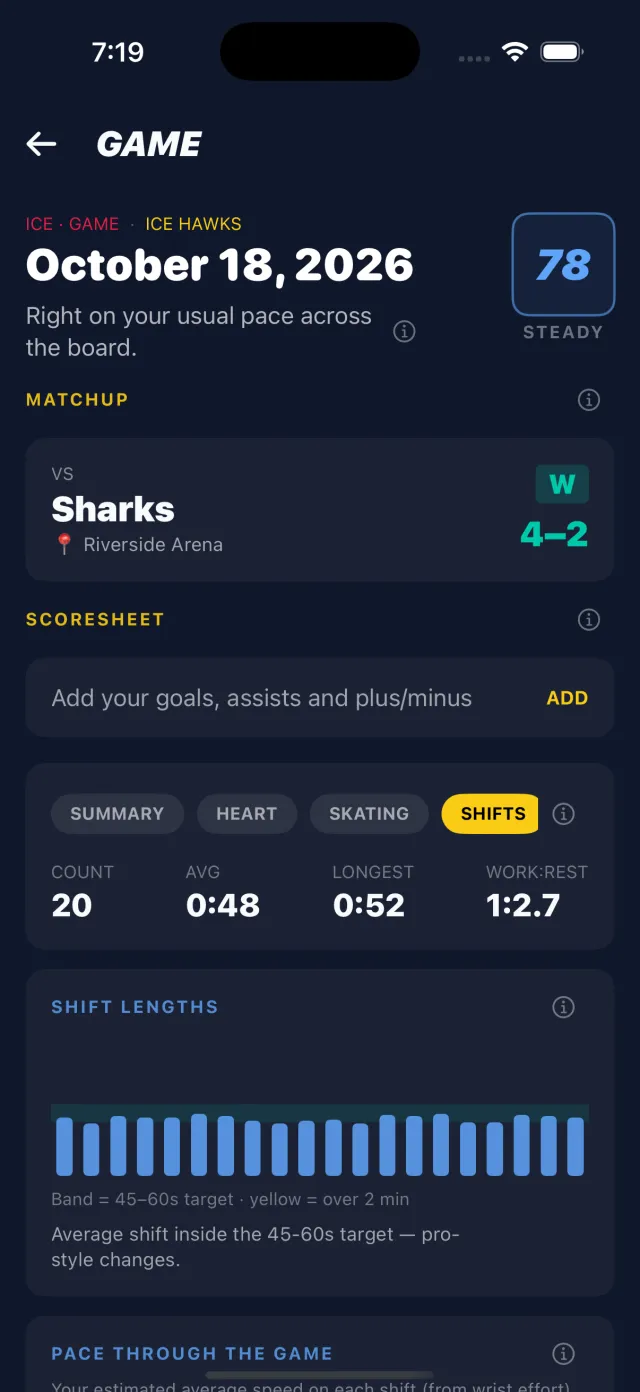
Almost nobody does. Shifts feel shorter than they are, and a stopwatch on the bench doesn't survive the first period. A smartwatch can do it for you. NextShift tracks every shift from your wrist, with no buttons to press, and shows each one against the 45 to 60 second band, with anything over two minutes highlighted. After a few games you'll know whether you're the player who stays out too long.
Want to know how the watch tells a shift from a rest? Read what shift detection is and how it works.